
The History of American Art in 25 Iconic works, Thursday 5th February 2026
A sell-out crowd greeted Dr. Anne-Marie Mancio, when she came to give our first Special Interest Day of the Year on 5th February 2026 at our usual Henley Rugby Club venue.
Marie-Anne took us on a three hour journey through American history, both social and economic, as shown by 25 ‘iconic’ American works of art. Though some were familiar as they are known throughout the Western world, most were new to many people, as virtually none are in British art collections.
The first session explored the early years of American painting, when artists very much looked to Europe and its prestigious history paintings. Most famous of the 18th century American artists was John Singleton Copley, whose ‘Watson and the Shark’ was exhibited at the Royal Academy in London in 1778 and put American art on the map. Many artists of the time, though looking to the genre of history painting, used American themes.
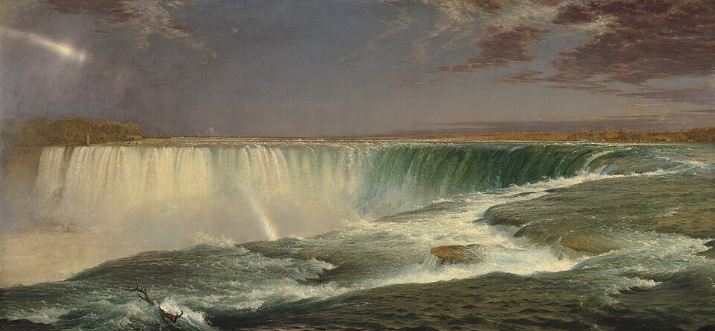
Paintings documented change - the capital city moving to Washington and the treaty of Guadeloupe, incorporating many new states including California into the Union. By the 19th century and coinciding with the invention of photography and the expansion of the West, the protection of the environment became a theme, as well as the bounty of nature. These were subjects beloved by the Hudson River School, which included Frederick Church with his dramatic pictures of Niagara, Thomas Cole and Albert Bierstadt who documented expeditions as they went West.
More familiar to most of us were the paintings of arch rivals James McNeil Whistler and John Singer Sargent. Both of these Americans settled and painted mainly in Europe, Paris and London respectively. Their Romantic style led on to the realism of Thomas Eakins and American Impressionism, where the influence of Japanese art, already espoused by Whistler, becomes ever stronger in the work of Mary Cassatt and others. Americans were more amenable to the new style and less prejudiced against women artists so that Cassatt, taken up particularly by Degas, even exhibited at the 1st Impressionist Exhibition in 1874. She developed a close friendship with wealthy American collector Louisine Havemeyer, putting on an Impressionist exhibition in New York, which profoundly affected the ongoing American acquisition of European art and explaining why so much is still held in American galleries.
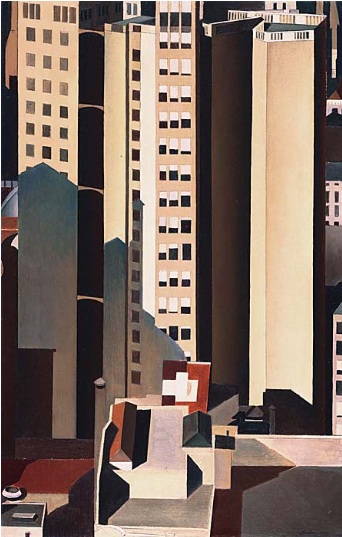
In the second lecture we looked at how much art reflected the boom in immigration and the issues that arose as the new country boomed. This is heavily represented by the Ashcan School, who painted scenes of everyday life, the wealthy side by side with the poor. By the 1920s a truly American style of art had evolved represented by Charles Sheeler with his precise paintings of the new skyscrapers and burgeoning industrial scene, represented by the Ford plant.
Georgia O’Keefe also started by painting skyscrapers but, concerned that people were not taking enough heed of nature, she turned to painting flowers. She dismissed suggestions that these had sexual connotations and her ‘Cow’s Skull - Red, White and Blue’ was an attempt at making The Great American Painting.
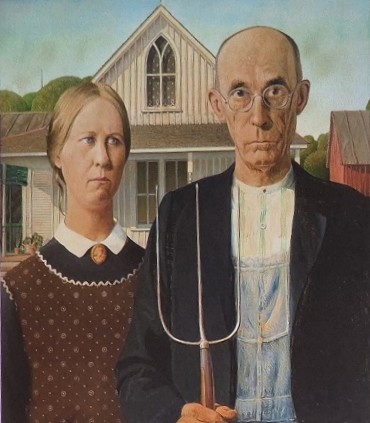
Grant Wood’s famous ‘American Gothic’ of 1930 evokes the American spirit of resilience and resistance at a difficult time for the country. Most of us were surprised to hear that the models were actually Wood’s sister and his dentist. They represent a father and daughter, but unusually the man stands on the right reflecting a Flemish Renaissance influence.
The photos of Dorothea Lange (‘The Migrant Mother ‘1936) have become important in documenting the Great Depression, a time when art and literature became either realist or escapist.
Edwin Hopper had been to Europe and was unimpressed by the lack of realism in the Impressionists . Trained in the Ashcan school and influenced by the growing film industry, his paintings often capture alienation most famously in ‘Nighthawks’ (1942). Though they had a tempestuous relationship, all the women in his paintings are his wife. For all his realism none of his paintings included a black figure.
Jacob Lawrence (1917 -2000) however tells the stories of Afro-Americans who moved North after the Abolition, with a series of 60 panels called ‘The Migration Series’ (1940 -1941).
In the third session we looked at how the Cold War encouraged the CIA, in a form of propaganda, to fund Abstract Expressionism as an All American art style. Rejecting the regionalism that had preceded him, Jackson Pollock (“Jack the Dripper’) was influenced by Navajo sand painters, leading him to work on the floor. Art became about the work itself without context. It was about an inner emotional world, as exemplified by Mark Rothko, in complete contrast to the Russian realism of the time.
Other painters such as Jasper Johns and Robert Rauschenberg rebelled against this and foreshadowed the Pop Art of Roy Lichtenstein and Andy Warhol, whose Factory recalled the workshops of Renaissance masters.
The day ended with a round up of mid 20th century ‘conventional’ artists and the 1960s and 70s ‘land art’ of Nancy Holt (‘Sun Tunnels’) and Robert Smithson (‘Spiral Jetty’).
After a wonderful day in the hands of an engaging, fluent and knowledgeable lecturer we were just left feeling frustrated that we couldn’t see any of these works without a trip to the USA.
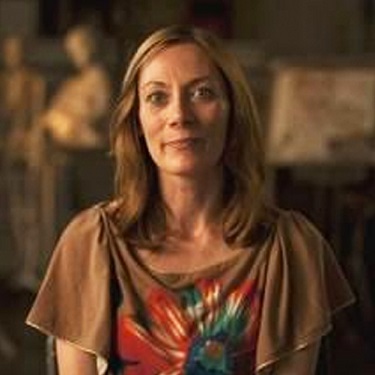 Dr Marie-Anne Mancio, MPhil, DPhil, is an art historian, writer, experienced tour leader and Arts Society accredited lecturer. Marie-Anne originally trained as an artist before gaining a DPhil in Art and Critical Theory at the University of Sussex. She has written and presented courses for Tate and Dulwich Picture Gallery. She has lectured in art history for the City Lit, Tate Modern, the Course, Art in London, V&A, Dulwich Picture Gallery, HENI films, Ben Uri gallery. She also runs art history study tours abroad for ACE and is a Director of InFems art collective for whom she curates exhibitions and writes.
 She writes reviews, catalogue essays and historical fiction and is a frequent visitor to Italy. She is currently writing a book about Caravaggio.
DPhil in Art and Critical Theory, University of Sussex
MPhil Creative Writing, University of Glasgow