
Chris Bradley
Review of the lecture:
The December Christmas lecture, given by Chris Bradley, had a very appropriate seasonal theme, on the life of St Nicholas and how he became the origin of Santa Claus.
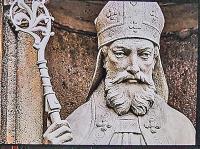 St Nicholas was born in Patara in south-west Turkey. His parents died while he was young, and he inherited a substantial sum of money. He became known for giving gifts, including dowries for three young sisters so they could get married. He became Bishop of Myra, and was one of the delegates to the Congress of Nicaea, which debated many early Christian doctrines, including the nature of the Trinity, hence the stories associated with St Nicholas of gifts given three times. The conclusions of the Congress are encapsulated in the Nicene Creed, still in use today. St Nicholas’s reputation as a miracle worker and protector continued to grow, and he became the patron saint of sailors. In the 11th century, fearing that Islamic groups would overrun Turkey and destroy his remains, sailors from Bari took most of his skeleton back to Bari. Not to be outdone, Venetian sailors then took the small bones remaining him his tomb back to Venice. Both Venice and Bari later gave some small bones to important nobles elsewhere in Europe as objects of veneration.
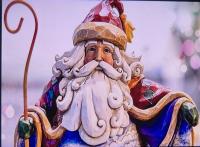 Sailors throughout Europe continued to venerate St Nicholas, and in The Netherlands a tradition developed of giving gifts on his saint’s day, December 5th. His name was corrupted in Dutch to Sinterklass. When the Dutch established colonies in North America, the name further changed into the familiar Santa Claus. The red costume comes from a bishop’s colour of cassock, and the familiar beard, round body and boots come from traditional winter myths of the green man. In art, Santa Claus was originally depicted in a horse-drawn sleigh, with the addition of reindeer, a home at the North Pole and elves as helpers coming from Nordic myths. In some cultures, gifts are still exchanged on December 5th, but in the anglophone world the date has changed to being at Christmas. The talk was very well-illustrated with both archaeological evidence and of pictures of St Nicholas through the centuries.
 ~~~~~~~~~~~~~~~~~~~~~~~~~~~~~~~~~~~~~~~~
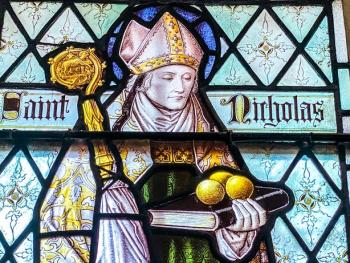
Nicholas was the Greek Bishop of Myra, a 4th century port in Anatolia. Following his death, his legendary generosity established him as the principle gift-giving saint as well as the patron saint of seafarers and children.
(Please click on the blue print above to continue reading)
The body of St Nicholas was stolen by Italian sailors to protect their own ports of Bari and Venice in the Adriatic. Over the centuries the image of St Nicholas changed constantly until the Dutch re-invented him as Sinterklaas.

Taking him to their new colonies in America, he transformed into kindly Santa Claus. Later re-imported into Britain without his Catholic baggage, he gradually emerged as Father Christmas.

Chris is an expert in the history and culture of the Middle East and North Africa. As a professional tour guide and lecturer he has led groups throughout the Middle East and Asia. He writes extensively on Arabia and is the author of the Insight Guide to the Silk Road and Berlitz Guides to Cairo; Abu Dhabi, Nile Cruising, Libya; the Red Sea; Oman and the Discovery Guide to Yemen. As a photographer he has pictures represented by several photographic libraries. As a film producer and cameraman he made documentaries for the BBC, National Geographic TV and Channel 4.